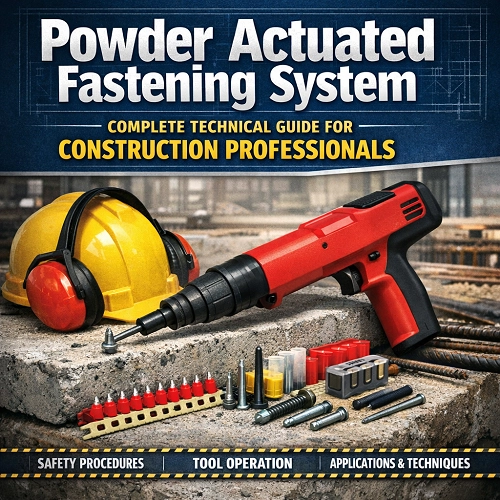
A Powder Actuated Fastening System (PAFS) is an industrial tool platform that uses the controlled combustion energy of a powder load (also called a power load or cartridge) to drive hardened steel fasteners directly into hard base materials such as concrete, structural steel, masonry, and composite substrates — without pre-drilling, anchoring, or welding. The technology is the single most productive fastening solution available on construction jobsites worldwide, and has been a cornerstone of the building industry for over six decades.
A complete PAFS consists of three main components working in concert: the power actuated tool (the driver), the powder load (the energy source), and the drive pin or fastener (the structural element). When the system fires, expanding propellant gases accelerate the fastener to the precise velocity needed for permanent, load-bearing embedment into the substrate.
The operating principle combines controlled pyrotechnics with precision mechanical engineering. When the tool is pressed against a surface and the trigger is engaged, a firing pin strikes the primer of the powder load cartridge. The primer ignites the propellant charge, generating rapidly expanding combustion gases. These gases are channeled through the tool's barrel, driving a piston — and through the piston, the fastener — forward at high velocity.
There are two fundamental drive principles in PAT design:
| Drive Type | Working Principle | Best For | Typical Fastener Velocity |
|---|---|---|---|
| Direct Drive | Combustion gases act directly on the fastener shank | Thin steel plates, softer substrates | 400–600 m/s |
| Indirect Drive (Piston) | Captive piston transfers energy; decelerates before exiting barrel | Concrete, hard structural steel, masonry | Controlled: 20–80 m/s at point of entry |
Table 1 — Direct vs. Indirect Drive Comparison
Modern professional-grade systems predominantly use the indirect (piston) drive principle, which greatly reduces the risk of substrate spalling, fastener ricochet, and tool damage, while delivering more consistent penetration depth — a critical variable for structural compliance.
Penetration depth is governed by four interacting variables: powder load power grade, fastener shank diameter and length, substrate hardness (measured in Brinell or Rockwell scale for steel, or compressive strength for concrete), and tool piston travel. Selecting the correct combination is essential — an under-powered shot produces a fastener that sits proud and lacks pullout strength, while an over-powered shot can crack concrete or create dangerous spalling.
The modern market offers three primary actuation technologies. Each offers distinct advantages depending on jobsite conditions, volume requirements, and operator preference.
| Category | Energy Source | Noise Level | Best Application | Regulatory Req. |
|---|---|---|---|---|
| Powder Actuated Tool (PAT) | Powder load cartridge (.22 or .27 cal) | High (120–140 dB) | Heavy structural, outdoor, high-volume | Operator training required in most regions |
| Gas-Actuated Tool | Combustible gas + battery ignition | Moderate (90–105 dB) | Indoor framing, MEP installations | Standard operator certification |
| Battery-Powered Nail Gun | Li-ion battery driven solenoid | Low (75–88 dB) | Ceiling, light gauge steel, retrofit work | Minimal — no cartridge regulations |
Table 2 — Tool Category Comparison by Energy Source, Noise, and Application
Traditional powder actuated tools remain the industry's workhorse for demanding structural applications. Models such as the Jinhow PAT 307 and PAT 308 are engineered with adjustable power settings, hardened alloy steel barrels, and integrated load-strip indexing to maximize throughput and reduce misfires on structural steel and concrete surfaces.
Gas-actuated tools eliminate the cartridge-based powder load, using a small canister of combustible gas combined with battery-powered electronic ignition. This produces a quieter, low-recoil shot well suited to interior installations such as metal stud framing, electrical conduit support, and HVAC bracketing. The Jinhow Gas-Actuated Nail Gun supports both magazine-fed and single-shot operation, with sequential firing rates up to 2 shots per second.
Battery-powered fastening tools represent the fastest-growing segment of the market, driven by noise regulations, indoor air quality requirements, and improved Li-ion energy density. These tools are particularly valued for ceiling fastening applications, where overhead operation demands light weight, minimal recoil, and consistent power without cartridge reloading interruptions.
Power actuated fasteners are precision-engineered components manufactured from high-carbon alloy steel, heat-treated to achieve the hardness necessary to penetrate concrete and structural steel without fracturing. Selecting the correct fastener geometry is as important as selecting the correct tool and load.
| Fastener Type | Shank Diameter | Available Lengths | Washer | Primary Use |
|---|---|---|---|---|
| Standard Drive Pin (smooth shank) | 3.0 mm / 3.7 mm | 17–72 mm | Optional | Concrete, steel-to-concrete |
| Knurled Shank Drive Pin | 3.7 mm / 4.5 mm | 20–60 mm | Integrated / Optional | Structural steel, heavy load |
| Threaded Stud (M6–M10) | 3.7 mm body | 25–60 mm body + thread | Not applicable | Hanging loads, conduit supports |
| Fluted Shank Pin | 3.0–4.0 mm | 15–50 mm | Integrated plastic | Ceiling track, light gauge steel |
| Eyelet Pin | 3.7 mm | 20–40 mm | Integrated washer | Cable trays, wire management |
Table 3 — Drive Pin & Fastener Types, Dimensions, and Applications
Fastener surface treatment is equally important. Standard zinc-plated pins are suitable for dry interior environments, while hot-dip galvanized or stainless steel variants are specified for exterior, coastal, or chemically aggressive environments where corrosion resistance is critical to long-term structural performance.
Powder loads (power loads) are the energy cartridges that drive the fastening system. They are classified by caliber, charge weight, and power level — and are color-coded to an internationally recognized standard to prevent field errors.
| Color Code | Power Level | Charge Strength | Recommended Substrate |
|---|---|---|---|
| Gray | 1 — Lightest | Minimum | Soft wood over thin steel sheet |
| Brown | 2 | Light | Light concrete, wood-to-steel |
| Green | 3 | Moderate | Standard concrete (<20 MPa) |
| Yellow | 4 | Medium-High | Normal concrete (20–30 MPa), structural steel |
| Red | 5 | High | Hard concrete (>30 MPa), heavy structural steel |
| Purple | 6 — Highest | Maximum | Hardened steel, very dense concrete |
Table 4 — Powder Load Color-Code System (Standard International Convention)
Because powder actuated tools involve rapid-release energy and hardened projectiles, they are subject to rigorous international safety standards. Operators, manufacturers, and importers must comply with applicable national and international regulations.
Certifications held by Jinhow Technology products:
All operators of powder actuated tools are strongly advised to complete manufacturer-certified training before use. Most jurisdictions require proof of training for professional jobsite use, and tool manufacturers including Jinhow Technology provide multilingual operation manuals and safety guides with every product.
Founded in 2007 and headquartered in Jiaxing, Zhejiang Province — strategically located near Shanghai, Hangzhou, and Ningbo — Jinhow Technology has grown into a leading manufacturer and global exporter of powder actuated fastening systems. With a comprehensive product portfolio spanning powder actuated tools, battery-powered nail guns, gas-actuated systems, drive pins, and power loads, the company serves contractors and distributors across more than 30 countries worldwide. All products are produced to international standards and are eligible for OEM/ODM customization including brand logo, gun body color, interface specification, and language-specific documentation.
Professional-grade tool with adjustable power settings. Designed for concrete and structural steel fastening with strip-feed efficiency.
View Product →Compact pistol-style PAT for single-shot precision work. Ideal for retrofit fastening and restricted-access sites.
View Product →High-velocity drive tool supporting a full range of drive pins and power loads for demanding structural applications.
View Product →Quiet, low-recoil gas-powered tool for indoor MEP and framing. Eliminates powder cartridge regulations for most indoor environments.
View Product →Li-ion driven for cordless, low-noise fastening. Outstanding for ceiling installations and high-frequency interior work.
View Product →Heavy-duty construction nail gun engineered for the highest-demand substrates, including hard concrete and thick structural steel.
View Product →Jinhow also supplies a full range of power actuated fasteners including smooth and knurled drive pins, threaded studs, eyelet pins, and plastic-collared ceiling nails — as well as gas power actuated system components. All fasteners are manufactured from high-carbon alloy steel, heat-treated and surface-treated to specification, and available in standard or custom strip configurations for high-volume applications.
Yes, but with caution. Lightweight concrete (typically below 17 MPa compressive strength) requires careful load selection — usually one or two power grades below what would be used for normal-weight concrete. Always verify minimum substrate thickness and conduct a test shot before proceeding with production fastening.
General industry guidance specifies a minimum edge distance of 75 mm (3 inches) from any free edge of concrete, and a minimum center-to-center spacing of 50 mm (2 inches) between adjacent fasteners. Structural drawings may specify greater distances depending on load requirements — always refer to the project engineer's specifications.
After every working day, or after each 500–1,000 shots, the tool barrel, piston, and exhaust ports should be cleaned with the manufacturer-supplied brush and solvent-free lubricant. Never use penetrating oil lubricants inside the barrel, as residue can affect powder load performance. Inspect the firing pin and piston seals quarterly and replace as required per the tool manual.
In most countries and US states, operators of powder actuated tools (PAT) must hold valid manufacturer-issued or nationally recognized certification. Battery-powered and many gas-actuated tools do not require formal certification, though proper training is always recommended. Jinhow Technology supplies multilingual operation manuals and supports partner training programs.
Yes. Jinhow offers full OEM/ODM services covering gun body color, brand logo, safety label language, packaging design, and interface specification adjustments to match regional standards. The company's export compliance team handles CE, UL, GS, and other certification documentation for international orders. Contact the sales team for minimum order quantities and lead times.