01 What Are Powder Actuated Fastening Systems?
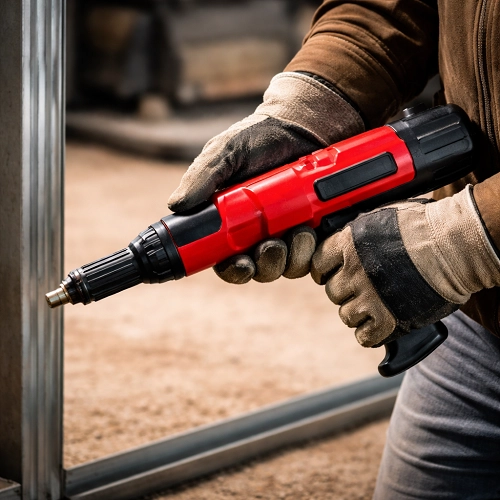
A Powder Actuated Fastening System (PAFS) is a category of industrial tool that uses a controlled propellant charge — typically a small, precision-engineered powder cartridge — to drive a hardened fastener directly into concrete, structural steel, or masonry. These systems eliminate the need for pre-drilling in most applications, delivering dramatically faster cycle times compared to conventional anchoring methods.
The technology was first commercialized in Europe during the 1940s for post-war reconstruction, and has since evolved into a family of precision tools used across construction, shipbuilding, power generation, and civil infrastructure. Modern systems are engineered to comply with international safety standards such as ISO 11684 and regional regulations governing the use of explosive-actuated fastening tools.
02 How They Work: Mechanism & Physics
When the operator presses the tool muzzle flush against the work surface and actuates the trigger, a firing pin strikes the powder load (cartridge). The controlled deflagration — not a detonation — produces a rapid gas expansion that drives the piston forward. The piston, in turn, transfers kinetic energy to the fastener, embedding it into the base material.
Direct-Drive vs. Indirect-Drive
There are two fundamental piston configurations in powder actuated tools:
| Parameter | Direct Drive | Indirect Drive (Piston Drive) |
|---|---|---|
| Working principle | Fastener acts as the projectile | Separate piston transfers energy to fastener |
| Base material suitability | Soft to medium-hard materials (wood, thin steel) | Concrete, hard masonry, thick structural steel |
| Energy efficiency | Higher per shot | More controlled; lower peak stress |
| Fastener damage risk | Moderate | Low (piston absorbs shock) |
| Typical application | Decking, framing | Structural steel-to-concrete; MEP hangers |
03 Tool Types & Classification
Manufacturers like Jinhow Technology produce several distinct tool families, each suited to different site conditions and operator skill levels. Understanding these categories is essential for specifying the right tool for a given project.
| Tool Class | Energy Source | Best For | Jinhow Product Line |
|---|---|---|---|
| Low-velocity powder actuated | Powder cartridge (rimfire) | General construction, concrete slab | Power Actuated Tool |
| Gas-actuated (combustion) | Fuel cell + electric ignition | High-volume, cordless ceiling work | Gas-Actuated Fastening Tool |
| Battery-powered | Rechargeable Li-ion battery | Indoor MEP, sensitive environments | Battery-Powered Fastening Tool |
| Ceiling-specific | Powder or gas | Overhead MEP hangers, suspended ceilings | Ceiling Fastening Tool |
| Gas power actuated system | Fuel cell + advanced piston | Demanding steel-to-concrete industrial use | Gas Power Actuated Systems |
The shift toward gas-actuated and battery-powered tools reflects a broader industry trend: reducing reliance on propellant cartridges in enclosed work sites where air quality, noise ordinances, or regulatory restrictions limit conventional powder tools.
04 Drive Pins, Studs & Fastener Selection
The fastener — commonly called a drive pin or drive stud — is the element that ultimately bears the structural load. Selecting the correct pin geometry, shank diameter, point style, and surface treatment is as critical as the tool choice itself.
Jinhow's Power Actuated Fastener catalog covers a broad dimensional range, manufactured from heat-treated alloy steel with surface hardness engineered to exceed the base material hardness without becoming brittle.
| Pin Type | Shank Ø (mm) | Typical Length (mm) | Point Style | Base Material |
|---|---|---|---|---|
| Smooth-shank nail pin | 3.0 – 3.7 | 17 – 72 | Tapered cone | Concrete, light masonry |
| Fluted / knurled pin | 3.0 – 4.0 | 20 – 60 | Diamond point | Hard concrete, structural steel |
| Threaded stud (M6/M8) | 3.7 – 4.5 shank | 27 – 92 | Blunt/chisel | Concrete slabs, steel beams |
| Eyelet pin | 3.0 | 20 – 40 | Tapered | Concrete (cable/pipe routing) |
| Clip/track pin | 3.0 | 15 – 25 | Flat | Steel sheet, light decking |
05 Powder Loads: Calibers, Colors & Charge Levels
Powder loads (also called cartridges or charges) are the propellant source for traditional powder-actuated tools. They are classified by caliber (physical size) and by charge strength, universally coded by a standardized color system.
| Color Code | Charge Level | Approximate Energy | Typical Use Case |
|---|---|---|---|
| Gray | 1 (lightest) | ~20–40 N·m | Thin steel into soft concrete |
| Brown | 2 | ~40–60 N·m | Light framing, drywall track |
| Green | 3 | ~60–80 N·m | Standard concrete, medium steel |
| Yellow | 4 | ~80–110 N·m | Hard concrete, structural steel |
| Red | 5 | ~110–140 N·m | Very hard concrete, thick plate |
| Purple / Violet | 6 (heaviest) | ~140–170 N·m | High-strength steel, bridge decking |
Caliber designations (.22, .25, .27, .32) refer to the internal bore diameter of the cartridge in inches — a legacy of early tool design influenced by conventional firearm standards. Today, the most common calibers used globally are .27 caliber (standard construction) and .22 caliber (lower-energy tools). Always verify compatibility between the load caliber and the tool's chamber specification before use.
06 Key Applications by Industry
Powder-actuated fastening systems are deployed across a wide spectrum of industries. The speed and load capacity of PAF systems make them the preferred fastening choice in high-volume environments where productivity and reliability are paramount.
| Industry | Typical Task | Recommended Tool Type | Fastener Type |
|---|---|---|---|
| Commercial Construction | Steel deck-to-beam, formwork | Low-velocity powder tool | Smooth shank pin |
| MEP / HVAC Installation | Pipe hangers, conduit clips | Gas-actuated or battery tool | Threaded stud, eyelet pin |
| Shipbuilding | Insulation attachment, cable trays | Low-velocity powder tool | Clip pin, fluted pin |
| Power Generation | Structural steel anchoring | Gas power actuated system | Knurled pin, threaded stud |
| Mining & Infrastructure | Tunnel lining, cable management | Powder or gas tool | Heavy-duty drive pin |
| Suspended Ceilings | Overhead MEP, ceiling grids | Ceiling fastening tool | Eyelet / stud pin |
For project-specific product recommendations across these sectors, contact Jinhow Technology's technical team directly. With over 18 years of manufacturing experience and distribution in more than 30 countries, Jinhow engineers are equipped to assist with application-specific fastener specification.
07 Safety Standards & Best Practices
Because powder-actuated tools use explosive propellant charges, they are regulated as a distinct category of hazardous tool in virtually every jurisdiction. In the United States, OSHA 29 CFR 1926.302(e) governs their use on construction sites; the EU follows EN 15895; and the international standard ISO 11684 applies to safety markings. Many jurisdictions require documented operator certification before an individual may use a PAF tool unsupervised.
- Never use a powder-actuated tool in a flammable or explosive atmosphere
- Always wear ballistic-rated eye protection and hearing protection
- Inspect the muzzle guard and safety before each use
- Never bypass the contact safety — the tool must be pressed firmly to the work surface before firing
- Store cartridges and tools separately, in manufacturer-specified containers
- Only use fasteners and loads specified by the tool manufacturer
- Never point the tool at any person, even if unloaded
- Mark all misfired cartridges and dispose of per local regulations
08 Jinhow Technology: Product Range Overview
Jinhow Technology (Zhejiang) Co., Ltd., headquartered at 180 Duijin Road, Xinfeng Town, Jiaxing, Zhejiang — adjacent to Shanghai, Hangzhou, and Ningbo — has been a specialist manufacturer of powder-actuated fastening systems for over 18 years. Their integrated manufacturing and export model, operated through Jiaxing Jinhow Import and Export Co., Ltd., serves clients in more than 30 countries.
The full product catalog spans six core categories, each engineered for specific application environments:
Tools
Power Actuated ToolClassic low-velocity tools for concrete and steel. Ideal for general structural fastening.
Tools
Battery-Powered Fastening ToolCordless, zero-emission solution for indoor or sensitive-environment projects.
Tools
Gas-Actuated Fastening ToolHigh-cycle gas combustion tool for fast-paced framing and ceiling applications.
Fasteners
Power Actuated FastenerComplete drive pin and stud range, heat-treated alloy steel in multiple lengths and point styles.
Systems
Gas Power Actuated SystemsAdvanced gas-piston systems engineered for demanding industrial environments.
Tools
Ceiling Fastening ToolErgonomic overhead tool for MEP hangers, ductwork support, and suspended ceiling grids.
Stay current with Jinhow's latest technical developments and product launches via the Industry News section, and follow factory updates and case studies at Company News. Video demonstrations and product gallery assets are available at Video & Gallery.
09 PAF vs. Alternative Fastening Methods
Selecting the correct fastening technology requires a systematic evaluation of site conditions, load requirements, regulatory environment, and total installed cost. The table below provides a high-level comparison against the most common alternatives.
| Method | Speed | Skill Level | Load Capacity | Equipment Cost | Best Scenario |
|---|---|---|---|---|---|
| Powder Actuated (PAFS) | ★★★★★ | Certified operator | High | Low–Medium | High-volume structural fastening |
| Drill & Chemical Anchor | ★★☆☆☆ | General labor | Very High | Low | Heavy point loads, post-installed |
| Drill & Mechanical Anchor | ★★★☆☆ | General labor | High | Low | Medium loads, reusable connections |
| Pneumatic Nail Gun | ★★★★☆ | General labor | Low–Medium | Low | Wood framing, light applications |
| Welding / Stud Welding | ★★★☆☆ | Certified welder | Very High | High | Permanent steel-to-steel connections |
10 Buyer's Selection Guide
Use this checklist when specifying a powder-actuated fastening system for a new project:
| # | Parameter | Questions to Answer |
|---|---|---|
| 1 | Base material | Concrete strength class? Steel grade and thickness? Masonry type? |
| 2 | Fixture material | What is being fastened — steel track, wood, conduit bracket? |
| 3 | Load requirement | Static, dynamic, seismic? What is the design tensile/shear load? |
| 4 | Environment | Interior / exterior? Corrosive, wet, or high-temperature conditions? |
| 5 | Volume & speed | How many fasteners per shift? Is cycle time a key KPI? |
| 6 | Regulatory | Are powder tools permitted on site? Is operator certified? |
| 7 | Supplier support | Is technical support, training, and spare parts available locally? |
For a tailored recommendation, contact Jinhow's technical sales team with your project specifications. The company offers factory-direct pricing, flexible customization, and global logistics support backed by more than 18 years of specialized manufacturing experience.